How to Ship a Car to Another State: 6 Steps From Quote to Delivery
To ship a car to another state, get at least three quotes on the same terms, look up the broker’s and the carrier’s registration with FMCSA, and get the price, pickup window and deposit terms in writing. Then prepare the car, inspect it with the driver at pickup and note any damage on the bill of lading, and inspect it again at delivery before you sign and pay. On a cross-country move, plan on 7–10 days on the truck after a pickup window of one to five business days (see how long it takes to ship a car).
The steps at a glance
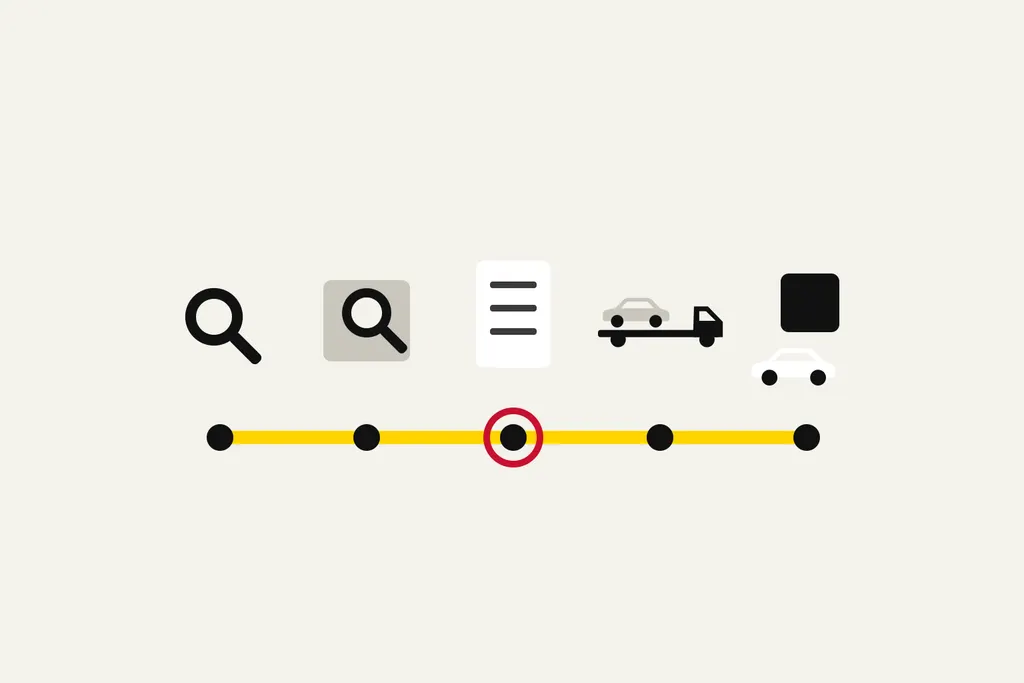
| Step | When | What you need |
|---|---|---|
| 1. Get and compare quotes | 2–3 weeks before the car is ready | Both ZIP codes, year, make and model, running or not, open or enclosed |
| 2. Check the broker and carrier | Before you pay anything, and again when the carrier is assigned | MC and USDOT numbers |
| 3. Book in writing | When you choose a quote | Total price, pickup window, deposit terms, the carrier’s insurance |
| 4. Prepare the car | The day before pickup | Photos, personal items out, no more than a quarter tank |
| 5. Pickup inspection | Pickup day | You or an adult you name, the bill of lading |
| 6. Delivery inspection and payment | Delivery day | Your photos, the balance due |
The 2–3 weeks comes from Sherpa Auto Transport, a broker, which recommends “booking 2-3 weeks in advance for the best rates and carrier availability.”
1. Get and compare quotes
Every company needs the same basics. FreightWaves Checkpoint, a consumer guide with an advertiser disclosure and quote links, lists your origin and destination and “the make, model, year, and operational status of your vehicle.” It also advises “getting three or more quotes.” Quotes don’t keep for long: “Most quotes are only valid for 24–48 hours,” FreightWaves says.
Compare like with like. A price for open transport, door-to-door, with a five-day pickup window can’t be compared with one for enclosed or expedited pickup. Ask each company whether its price is binding, because FreightWaves warns that “Many auto shipping companies do not provide binding estimates.” Ship A Car, a broker, adds that quotes for the same route “should cluster in a band,” and a number far below the rest is a warning sign. For a baseline before you call anyone, try the site’s calculator.
2. Check the broker or carrier with FMCSA
The company that quotes you may be a broker, not the trucking company that will move your car. FMCSA’s 2015 consumer advisory on car shipping puts it plainly: “Auto brokers only arrange the transportation of your car.” It also says:
- “Both auto transport brokers and carriers that operate interstate are required to be registered with FMCSA.”
- “Be suspicious of any Web site where it is not clear whether the company is a broker or a transporter.”
- “Avoid any auto transporter or broker that does not prominently display their MC Docket number on their website.”
Look the numbers up in FMCSA’s records, whichever the company gives you. The brokers quoted on this page show theirs differently: Sherpa Auto Transport and Ship A Car list both a USDOT and an MC number, and Web Auto Transport’s help pages list a USDOT number. The Broker Check on the same calculator page opens the official search for a USDOT or MC number. If you book through a broker, check again when it names the carrier. How to tell the two apart and what to look for in the record is in how to choose a car shipping company.
3. Book: what to get in writing
Before you pay, get four things in writing: the total price, the pickup window, the deposit terms and the carrier’s insurance. Ask the carrier for its certificate of insurance and read what it excludes. FreightWaves lists what to check on it: the cargo coverage, the “Coverage limit,” the “Deductible amount” and the “Policy effective dates.” More in car shipping insurance.
On payment, the brokers quoted on this page describe their own terms like this:
| Broker | When you pay |
|---|---|
| Web Auto Transport | “$0 at booking.” A “small partial payment” after “a verified carrier is assigned,” and the rest “paid directly to the driver at delivery” |
| Ship A Car, Inc. | “no payment due until a vetted carrier is confirmed” |
| Sherpa Auto Transport | “Pay remaining balance (credit card, cash, or check)” at delivery |
FMCSA’s 2015 advisory adds payment advice of its own: “If you make payments by credit or debit card, closely monitor the transactions with that company.” Warning signs around deposits are in car shipping scams and how to check a broker.
4. Prepare the car for pickup
Ship A Car’s list: “Wash the car so the pickup inspection is accurate, photograph it from all angles, remove personal items and toll tags, leave no more than a quarter tank of gas, and note any existing damage.” It also says to “Fix or flag fluid leaks before pickup.” FreightWaves Checkpoint adds photos of “the odometer and VIN plate.”
Personal items are where policies differ:
| Source | Personal items in the car |
|---|---|
| FreightWaves Checkpoint | “Most carriers don’t allow personal items in the vehicle during transport,” and loose items “aren’t covered by the carrier’s insurance” |
| Sherpa Auto Transport (broker) | “up to 100 lbs of personal items stored in the trunk area or below the window line,” but “Sherpa and carriers cannot be held responsible for personal items” |
Ask your carrier and get its answer in writing. If the car doesn’t run, say so when you ask for quotes. Sherpa says it “must still be able to roll, brake, and steer to be loaded onto a standard carrier.”
5. Pickup inspection and the bill of lading
The bill of lading is the paper you and the driver sign at pickup and again at delivery. Sherpa calls it “the official transport receipt.” Sherpa says “you or a designated adult representative must be present” and lists what that person does: “Inspecting the vehicle with the driver and noting its condition” and “Signing the Bill of Lading.”
FreightWaves Checkpoint’s pickup checklist: “Review the bill of lading inspection report carefully,” “Make sure all existing damage is marked accurately,” and “Do not sign until everything is correct.” Keep your copy.
6. Delivery inspection and payment
At delivery, inspect before you sign or hand over the balance. FreightWaves Checkpoint’s delivery checklist:
- “Inspect the vehicle immediately in good lighting”
- “Compare the car to your pre-shipping photos”
- “If you see damage, note it on the bill of lading before signing”
- “Take new photos and ask the driver to confirm the damage in writing”
It also warns: “Never sign delivery paperwork that says ‘received in good condition’ if you notice damage.” If there is damage, FreightWaves says to “file a claim with the carrier’s insurance right away.” FMCSA’s 2015 advisory says complaints against auto transporters and brokers can be filed through its website, linked in the advisory.
After the car arrives
Moving for good? Your new state’s motor vehicle agency sets the deadline for plates and registration. In Washington, for example, the Department of Licensing says: “You have 30 days after moving to Washington to get your driver license and register your vehicle.” Check your new state’s DMV site for its rules.
Before paying a deposit, check the company's USDOT or MC number.
Illustrations on this page are AI-generated to help you picture the situation. They are not photos of real homes, jobs or people.
Sources
- FMCSA — Consumer Advisory About Automobile Transporters (2015; last updated Feb 10, 2015)
- FreightWaves Checkpoint (consumer guide with an advertiser disclosure and quote links) — Car Shipping Cost Calculator: Instant Car Transport Quotes (updated May 29, 2026)
- FreightWaves Checkpoint (consumer guide with an advertiser disclosure and quote links) — Open vs. Enclosed Car Shipping: Which Should You Choose in 2026? (Feb 27, 2026)
- Sherpa Auto Transport (broker) — Car Shipping Cost Calculator, «How It Works» and FAQ (updated July 2026)
- Web Auto Transport (broker) Help Center — How Much Does It Cost to Ship a Car? (updated June 30, 2026; Q&A «Do you charge upfront?»)
- Web Auto Transport (broker) Help Center — Expedited vs. Standard Car Shipping (updated June 30, 2026)
- Ship A Car, Inc. (broker) — What is the Average Cost to Ship a Car Per Mile? (updated Sept 5, 2026; preparation tips, quotes, USDOT and MC in the text)
- Washington State Department of Licensing — Moving to Washington: Vehicle registration and plates (accessed Nov 2, 2026)
Updated November 2, 2026