Open vs Enclosed Car Transport: Price Gap and When It's Worth It
Open transport is the cheaper default and the easier one to book; enclosed costs more and buys protection from weather and road debris. FreightWaves Checkpoint, a consumer guide with an advertiser disclosure and quote links, puts enclosed at “30%–60% more than open shipping.” Sherpa Auto Transport, a broker, reports an average of $1,852 for enclosed against $1,238 for open across its own shipments, or “about $614 more.” For an everyday sedan, SUV or pickup, the sources below point to open. Enclosed is what they name for luxury, classic, exotic, low and freshly painted cars.
Open vs enclosed at a glance
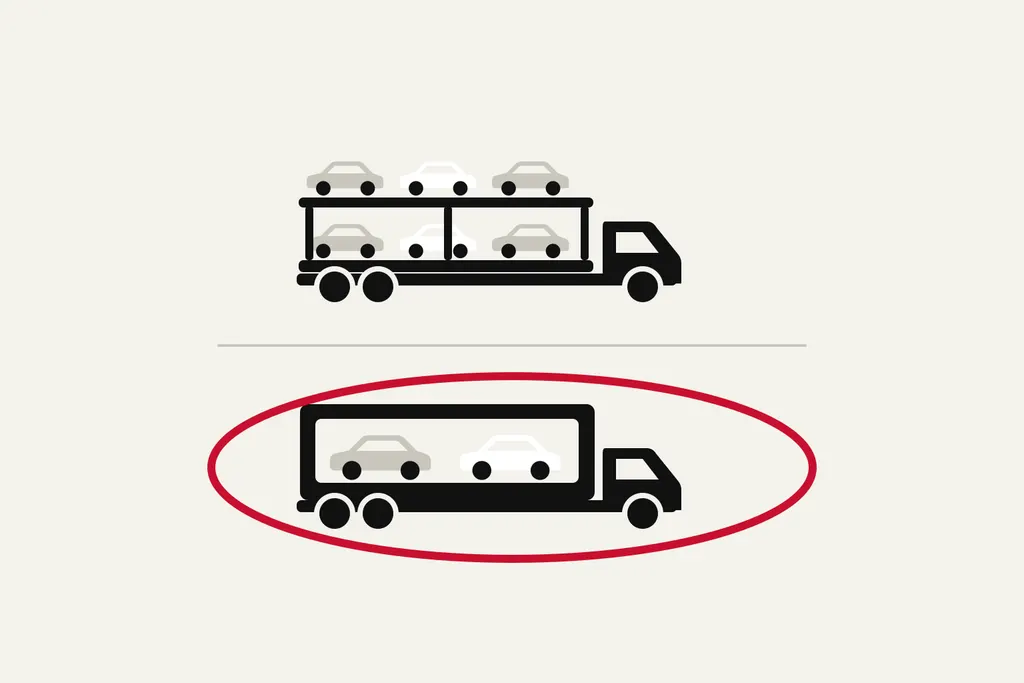
| Open trailer | Enclosed trailer | Who says it | |
|---|---|---|---|
| Price | Baseline | 30%–60% more | FreightWaves Checkpoint; Web Auto Transport (broker) gives the same +30–60% |
| Average paid | $1,238 | $1,852 | Sherpa Auto Transport (broker), its shipments |
| Cars per trailer | 7–10 | 1–6 | Web Auto Transport (broker) |
| Pickup window | 1–5 days | 3–10 days | Web Auto Transport (broker) |
| Weather and road debris | Exposed | Shielded | FreightWaves Checkpoint; Web Auto Transport |
| Share of shipments | about 93% of Sherpa’s customers | about 7% (our arithmetic from Sherpa’s counts) | Sherpa: 310,510 open vs 24,527 enclosed shipments |
Price difference in dollars and percent
FreightWaves Checkpoint’s calculator page publishes both trailer types for the same distances. Its prices are for an operable standard sedan:
| Distance | Open | Enclosed |
|---|---|---|
| 500 miles | $600–$700 | $850–$1,000 |
| 1,000 miles | $650–$800 | $1,000–$1,200 |
| 2,000 miles | $1,200–$1,400 | $1,700–$2,000 |
FreightWaves’ own open-vs-enclosed article prints different ranges for the same sedan, such as $350–$800 open and $600–$1,200 enclosed under 500 miles. Treat any one table as a rough guide, not a quote.
Sherpa’s numbers come from its own bookings across all routes and vehicles, so they describe what its customers paid, not the price of any one trip:
| Sherpa shipment data | Typical range | Average | Shipments |
|---|---|---|---|
| Open transport | $975–$1,450 | $1,238 | 310,510 |
| Enclosed transport | $1,425–$2,200 | $1,852 | 24,527 |
The percentage depends on who is counting:
| Source | Enclosed premium over open |
|---|---|
| FreightWaves Checkpoint (key takeaways) | 30%–60%; the same page also says enclosed “can cost up to 50% more” |
| Web Auto Transport (broker) | +30–60% |
| Sherpa Auto Transport (broker), ~2,000 miles | “averages 40-50% more” |
| Ship A Car, Inc. (broker) | “about a third above open” |
Two notes on these numbers. Web Auto Transport says the price difference between vehicle types “is about size and weight, not the value of your car,” so on the same trailer a pricier car doesn’t by itself cost more to ship. And the site’s calculator adds FreightWaves’ percentage range to the open price for your miles and vehicle. For enclosed prices in more detail, see enclosed car transport cost.
What an open trailer exposes your car to
FreightWaves Checkpoint says open trailers “are typically two-tiered,” and Web Auto Transport notes that “Manufacturers ship brand-new cars from factories on open trailers.” The risks the sources name are mostly cosmetic:
- Dust and grime. “It may collect dust or road grime, especially on long routes,” says Web Auto Transport.
- Weather and debris. FreightWaves Checkpoint: “While cars are exposed to weather, dust, and road debris, serious damage is rather rare.” Its FAQ adds that this “can lead to minor cosmetic issues like dirt buildup or small chips in rare cases.”
- Drips from the deck above. Web Auto Transport says you can request top-load, where the car rides on the upper deck “away from fluid drips from vehicles above.”
Enclosed lowers these risks but does not remove them. FreightWaves Checkpoint: “no transport method is 100% damage-proof.”
Which cars need enclosed
Only FreightWaves Checkpoint names a value, and loosely: it calls hard-sided enclosed trailers “Ideal for six-figure vehicles, rare classics, or long-distance winter shipments.” The other sources describe types of cars:
| Car | What the source says |
|---|---|
| Luxury, classic, exotic | Enclosed is “worth it for luxury, classic, or exotic vehicles” (FreightWaves Checkpoint) |
| Custom paint, a wrap, carbon fiber trim, lowered suspension | Listed as reasons to choose enclosed (Web Auto Transport) |
| Under 4 inches of ground clearance | Needs a liftgate, a hydraulic platform on enclosed trailers that “prevents undercarriage scraping” (Web Auto Transport) |
| Convertible with a soft top | “Technically yes” on open, “but enclosed shipping is recommended” (Web Auto Transport) |
| Long trips or winter | FreightWaves Checkpoint lists “shipping long-distance or during winter” and protection “from weather, dust, and salt” as reasons for enclosed |
Enclosed trailers aren’t all the same. FreightWaves Checkpoint separates hard-sided trailers, with “rigid aluminum or composite walls,” from soft-sided ones with “heavy-duty vinyl or canvas walls,” which “typically” cost “slightly less.” If you book enclosed for a low car, ask whether the trailer has a liftgate.
A pricier car also raises a coverage question on either trailer. FreightWaves Checkpoint suggests confirming “that the coverage limit applies per vehicle, not just per trailer load.” Ask the carrier for its certificate of insurance and read what it excludes. More on that in car shipping insurance.
Availability and scheduling
Enclosed costs you time as well as money, mostly before the car is loaded. FreightWaves Checkpoint: “Fewer enclosed carriers operate on any given route, which can extend your pickup window by several days.” Web Auto Transport gives 3–10 days for an enclosed pickup window against 1–5 days for open. It adds that “once picked up, transit speed is comparable to open transport.” Days on the road by distance are in how long it takes to ship a car.
How to decide
- Everyday car, normal paint: open. If drips from an upper deck worry you, ask for top-load.
- Low, modified, soft-top or show car: enclosed. Ask about a liftgate and how the car is tied down.
- Tight deadline: open has more trucks and shorter pickup windows, per the sources above.
- High-value car on any trailer: get the carrier’s certificate of insurance and check the per-vehicle limit before pickup.
- Still unsure: price both on the same dates and the same pickup window. The gap you’re quoted is the one that matters.
Want to cut the open price further? See the cheapest way to ship a car.
Before paying a deposit, check the company's USDOT or MC number.
Illustrations on this page are AI-generated to help you picture the situation. They are not photos of real homes, jobs or people.
Sources
- FreightWaves Checkpoint (consumer guide with an advertiser disclosure and quote links) — Car Shipping Cost Calculator: Instant Car Transport Quotes (updated May 29, 2026)
- FreightWaves Checkpoint (consumer guide with an advertiser disclosure and quote links) — Open vs. Enclosed Car Shipping: Which Should You Choose in 2026? (Feb 27, 2026)
- Sherpa Auto Transport (broker) — Car Shipping Cost Calculator, shipment data «Open vs. Enclosed Transport» (updated July 2026)
- Web Auto Transport (broker) Help Center — Open vs. Enclosed Transport: Which Is Right for You? (updated June 30, 2026)
- Web Auto Transport (broker) Help Center — How Much Does It Cost to Ship a Car? (updated June 30, 2026; «Cost by Vehicle Type»)
- Web Auto Transport (broker) Help Center — How Long Does Car Shipping Take? Transit Times by Route (updated July 21, 2026)
- Ship A Car, Inc. (broker) — What is the Average Cost to Ship a Car Per Mile? (updated Sept 5, 2026)
Updated November 2, 2026